BendiRip App Logo Icon
BendiRip
Print Shop Manager
Category Catalog Hub

Thermal & Piezo Wide-Format Printheads

High-Resolution 1200 DPI Micro-Fluidic Printhead Assemblies

The printhead is the ultimate engine of wide-format print precision. Jetting millions of micro-droplets per second with sub-micron spatial positioning, printheads dictate photographic sharpness, edge fidelity, gradient smoothness, and fine-line barcode readability.

Unlike legacy wide-format printers that rely on expensive technician-serviced piezo printheads costing thousands of dollars to replace, HP Latex technology utilizes user-replaceable thermal printheads. Print shop operators can hot-swap a fresh printhead in less than 90 seconds without specialized tools, service technicians, or costly machine downtime.

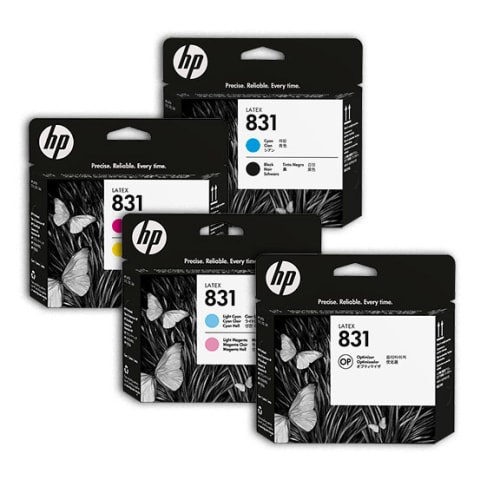
BendiShop stocks genuine OEM HP 831 and HP 836 thermal inkjet printheads, including CMYK, Light Cyan/Light Magenta, Optimizer, Overcoat, and recirculating White ink models. Every unit is factory-sealed, calibrated, and guaranteed for maximum nozzle yield.

Browse Subcategories:

Available Thermal & Piezo Wide-Format Printheads Products (2)

Certified commercial wide-format supplies in stock and ready for same-day dispatch.

Open Interactive Catalog →
HP Latex 836 Thermal Inkjet Printhead In Stock
HP Latex OEM HP Latex Printheads

HP Latex 836 Thermal Inkjet Printhead

HP Latex 836 Thermal Inkjet Printheads power the latest generation of HP Latex production printers, including the HP Latex 700, 700W, 800, 8...

Technology: HP Thermal Inkjet Micro-Fluidic Drop-on-DemandNozzle Count: 1,056 Nozzles per Color Channel (2,112 Total per Printhead)Native Resolution: 1200 DPI
HP 831 Latex Printhead In Stock
HP Latex OEM HP Latex Printheads

HP 831 Latex Printhead

HP 831 Latex Printheads are the proven production workhorse powering thousands of commercial print shops operating HP Latex 300 series (315,...

Technology: HP Thermal Inkjet Micro-Fluidic Drop-on-DemandNozzle Count: 1,056 Nozzles per Color Channel (2,112 Total per Printhead)Native Resolution: 1200 DPI
In-Depth Engineering Guide

Thermal Micro-Fluidic Resistor Architecture

HP Latex thermal printheads employ an array of micro-machined fluidic firing chambers, each equipped with a microscopic thin-film electrical resistor. When energized with an ultra-short electrical pulse, the resistor superheats the ink to over 570°F (300°C) in less than three microseconds. This creates a high-pressure microscopic vapor bubble that propels a 12-picoliter ink droplet through the nozzle at velocities exceeding 12 meters per second.

With 1,056 nozzles per printhead color channel running at 1200 native dots per inch, this architecture delivers ultra-dense drop placement that completely eliminates granular banding and delivers photographic skin tones, deep saturated blacks, and crisp 4-point typographic clarity.

Furthermore, HP Latex printers feature onboard Optical Drop Detectors (ODD) that automatically scan every individual nozzle during maintenance cycles. If a nozzle becomes misdirected or clogged, the printer firmware instantly maps an adjacent redundant nozzle to fire in its place, preserving print perfection mid-job.

Sign Shop Strategy

Printhead Life Maximization & Replacement Strategy

While HP Latex printheads are economically priced consumables, diligent maintenance significantly extends operational lifespan beyond warranty thresholds. Always ensure your printer maintenance cartridge cleaning roll is in good condition; a fresh cleaning fabric lubricates the printhead faceplate and clears dried pigment crusting without scratching delicate nozzle plates.

Never touch the gold electrical contacts on the back of the printhead with bare fingers, as natural skin oils cause electrical resistance and firing errors. If contact contamination occurs, gently clean the contact pads with an approved 20/20 lint-free foam swab dampened with distilled water or isopropyl alcohol.

Keep spare printheads on your shop shelf for all primary colors (Cyan/Black, Magenta/Yellow, Optimizer). There is nothing more costly in a commercial print shop than idling a $30,000 printer over a weekend due to a single exhausted printhead during a deadline fleet wrap job.

Standards & Testing

Commercial Specification & ASTM Laboratory Compliance

Every roll, cartridge, and component in the thermal & piezo wide-format printheads catalog is engineered and validated in accordance with rigorous commercial sign industry testing standards. Physical tensile strength and ultimate elongation are measured per ASTM D882, ensuring substrates withstand high-stress stretching over complex 3D vehicle contours and compound architectural recesses without structural tear or premature plasticizer breakdown.

Adhesive peel adhesion values are calibrated via ASTM D903 protocols against stainless steel, automotive clearcoats, and high-density polyethylene substrates. This standardized testing guarantees dependable initial tack for quick positioning, progressive 24-hour bond strength development, and clean removability without adhesive transfer when end-of-life graphics are stripped under controlled heat.

Flame resistance is rigorously certified for commercial interior and architectural installations under ASTM E84 (Class A interior flame spread) and NFPA 701 (textiles and flexible films). Furthermore, our printable substrates and OEM ink formulations comply with UL GREENGUARD Gold standards and European RoHS regulations, ensuring zero hazardous air pollutants (HAPs) and ultra-low VOC emissions suitable for healthcare environments, schools, and enclosed commercial facilities.

BendiRIP Integration

Harmonizing Thermal & Piezo Wide-Format Printheads with BendiRIP Color Engines

Achieving photographic print quality, vibrant chromatic saturation, and maximum outdoor service life requires precise synchronization between the RIP raster engine, ink deposit volume, curing heat profiles, and paired finishing components. When using BendiRIP, operators gain access to certified native color profiles that optimize drop placement and limit excessive ink loads.

High-performance sign shops running multiple print technologies—such as HP Latex alongside Roland TrueVIS or Mimaki solvent hardware—frequently struggle with color discrepancy across machines. BendiRIP unified color management uses spectral G7 calibration to achieve precise color matching across disparate ink chemistries and printer heads. When specifying thermal & piezo wide-format printheads, BendiRIP automatically synchronizes feed compensation, vacuum draw, and multi-pass interlacing to ensure flawless color consistency from proof to final installation.

Consult the BendiRIP hardware integration utility to automatically synchronize certified media profiles directly into your RIP queue. Production managers can monitor real-time square-footage media consumption, ink cost per square foot, and remaining roll yardage directly through the BendiStudio interface.

Lifecycle & Logistics

Commercial Inventory Management & Shelf Life Assurance

Managing commercial wide-format supplies requires disciplined first-in, first-out (FIFO) inventory protocols. Whether stocking sensitive printhead components, preventative maintenance assemblies, aqueous latex inks, or premium self-adhesive vinyl rolls, time and environmental exposure dictate reliability. Substrates and consumables in the thermal & piezo wide-format printheads portfolio feature individual batch tracking and expiration documentation to safeguard high-value customer production runs.

Store inventory inside a dedicated climate-stabilized storage zone maintained strictly at 59°F to 77°F (15°C to 25°C) and 35% to 55% relative humidity. Never store rolls, heads, or fluids in close proximity to direct thermal HVAC vents, loading dock bay doors, or chemical solvent cleaning stations. Elevated ambient temperatures accelerate polymer cross-linking in adhesives, evaporate humectants in water-based inks, and cause micro-crystallization inside printhead firing chambers.

By maintaining a minimum buffer stock of high-turnover consumables—including secondary maintenance cartridges, cleaning swabs, and matched overlaminate rolls—production managers protect their operations against catastrophic weekend downtime and emergency courier fees. BendiShop commercial accounts provide scheduled automatic fulfillment deliveries synchronized with your shop monthly square-footage output.

Thermal & Piezo Wide-Format Printheads — Technical FAQs

Expert technical answers addressing formulation, machine profiling, durability, and commercial installation.

How often should HP Latex printheads be replaced?

HP Latex printheads are rated for a warranty threshold of approximately 1,000 mL to 4,000 mL of ink jetted (depending on color and model). In well-maintained print shops, printheads frequently deliver 2,000 to 5,000 mL of reliable production before requiring replacement.

Do I need a certified service technician to replace an HP Latex printhead?

No. HP Latex printheads are 100% user-replaceable. Operators simply release the carriage latch, lift out the depleted printhead, slide in the new unit, and lock the latch. The machine automatically initializes, tests nozzles, and performs automatic optical alignment.

What is the purpose of the HP Latex Optimizer printhead?

The Optimizer printhead jets an unpigmented fixing agent that immobilizes color pigments upon contact with the substrate. This prevents ink coalescence and inter-color bleeding, enabling sharp text and vibrant solid fills at high carriage pass speeds.

How do HP 831 and HP 836 printheads differ?

HP 831 printheads are engineered for HP Latex 110, 300 series (315, 335, 365), and 500 series (560, 570) machines. HP 836 printheads are designed for the newer generation HP Latex 700, 700W, 800, 800W, and 630 series printers, featuring higher nozzle density and recirculating white ink architecture.

What causes nozzle dropouts in thermal printheads?

Nozzle dropouts are primarily caused by thermal resistor kogation (pigment crusting from running third-party inks), physical head strikes against warped media, or a depleted maintenance cartridge cleaning roll that fails to wipe the nozzle plate.

Can clogged printheads be soaked in cleaning solvents?

No. Never submerge thermal printheads in aggressive chemical solvents or ultrasonic cleaners, as harsh chemicals will dissolve internal adhesives and delaminate the nozzle plate. Wipe the nozzle plate gently using only 20/20 foam swabs dampened with distilled water.

How long can a spare printhead sit on the shelf?

Unopened printheads stored in their factory vacuum-sealed foil packs between 59°F and 86°F (15°C to 30°C) have a shelf life of approximately 18 to 24 months from manufacture date, clearly marked on the box packaging.

What happens if a printhead throws a "Reseat Printhead" error code?

Power down the carriage, open the latch, remove the printhead, and inspect the gold contact pins on both the carriage and printhead. Clean away any ink dust or oil residues using a dry lint-free swab, reseat firmly, and latch securely.