
SAi Flexi Subscription Pricing Analysis vs. BendiRip Lifetime: 5-Year TCO Breakdown
1. The Rise of "Software Rent-Seeking" in Wide-Format Prepress
Over the past decade, enterprise software vendors across every industry have pivoted aggressively toward software-as-a-service (SaaS) recurring subscriptions. While monthly recurring revenue (MRR) delights Wall Street investors, it has levied an unprecedented financial drain on independent commercial sign shops, wrap installers, and print-for-pay service providers.
Nowhere is this shift more pronounced than in RIP (Raster Image Processor) and sign-making suites. Historically, a sign shop purchased a perpetual license for SA International (SAi) FlexiSIGN-PRO or FlexiPRINT, installed it on their production PC, and operated it reliably for 7 to 10 years without paying a single extra penny.
Today, perpetual options have been systematically dismantled in favor of recurring monthly subscriptions. For prepress technicians and shop owners, this "software rental" model creates several acute financial and operational vulnerabilities:
- Compounding Long-Term Expense: A recurring fee of $69.99 to $99.99 per month feels manageable on a monthly credit card statement, but over a 5-year equipment lifecycle, that single seat drains $4,200 to $6,000 from company profit margins.
- The "Per-Printer Seat Tax": As soon as your shop purchases a secondary roll-to-roll printer (e.g., adding an Epson SureColor S80600 alongside an existing HP Latex 365), SAi charges an additional monthly printer seat fee ($25–$45/mo), directly penalizing shop growth.
- The Hostage Archive Dilemma: Because Flexi stores design work in its proprietary binary format (
.fs), the moment a shop cancels its subscription, it loses access to its own production history. Reprints, client revisions, and vector cut lines become unreadable without renewing payment.
For a typical 3-to-5-person commercial sign business producing $450,000 in gross annual sales, recurring RIP and design subscriptions represent an unnecessary fixed overhead cost that reduces net owner profit margins by 1.2% to 2.5% every single year.
2. 5-Year Total Cost of Ownership (TCO) Models: A Rigorous Audit
To understand the true economic impact, let us examine three realistic commercial shop configurations across a standard 5-year (60-month) operational timeline, comparing SAi Flexi subscription tiers against BendiRip Suite's perpetual lifetime model.
| Shop Profile & Fleet Size | SAi Flexi Subscription (5 Years) | BendiRip Lifetime Suite | 5-Year Net Shop Savings |
|---|---|---|---|
|
Tier 1: Single Operator 1 Roll-to-Roll Printer (HP Latex 365) 1 Vinyl Plotter (Graphtec FC9000) |
FlexiSIGN & PRINT $79.99/mo × 60 mo = $4,799.40 + estimated 8% rate increases: $5,183 |
BendiRip Lifetime + BendiCut One-Time Purchase: $699.00 Zero monthly fees (or $29/mo) |
$4,100.40–$4,484.00 saved (85%+ reduction) |
|
Tier 2: Mid-Size Sign Facility 2 Roll Printers (HP 570 + Epson S80600) 2 Cutters (Summa S Class 3 + Roland) |
Flexi Multi-Printer Bundle $139.99/mo × 60 mo = $8,399.40 + estimated rate increases: $9,071 |
BendiRip Lifetime (2 Workstations) One-Time Purchase: $1,398.00 Unlimited printers/cutters |
$7,001.40+ saved (83%+ reduction) |
|
Tier 3: High-Volume Production Shop 4 Printers (2x Latex, 1x Epson, 1x UV Flatbed) 3 Standalone Cutters & Flatbed Router |
Enterprise Flexi Multi-Seat $249.99/mo × 60 mo = $14,999.40 + estimated rate increases: $16,199 |
BendiRip Lifetime (3 Workstations) One-Time Purchase: $2,097.00 Unlimited LAN network seats |
$12,902.40+ saved (86%+ reduction) |
3. The Hidden Traps of Recurring Prepress Subscriptions
The financial cost is only half of the story. Recurring cloud licensing models introduce technical failure points that can paralyze a production facility during critical high-stakes print runs.
A. Mandatory Cloud License "Heartbeats" & Server Outages
Modern SAi Flexi installations require periodic internet "heartbeat" authentication to verify billing status with remote licensing servers. If your shop's internet service drops during an afternoon storm, or if SAi's central licensing server experiences an unscheduled outage (a scenario documented multiple times in industry forums), your RIP queue locks up. Print jobs waiting to be spooled to $30,000 hardware grind to a complete halt until connection is restored.
BendiRip's local-first cryptographic model: Your BendiRip license is authenticated cryptographically and runs 100% locally on your shop's Windows PC. It requires zero cloud connectivity to spool files, rasterize complex artwork, or drive cutters.
B. Billing Glitches & Expired Credit Cards
Commercial print shops frequently rotate corporate credit cards or update accounts. In a SaaS model, a single automated billing decline immediately puts your software into an unauthenticated state. Operators walking into the shop at 7:00 AM to start a 500-banner job are greeted with an activation lock screen, losing hours of billable press time while waiting for accounting to update payment details.
C. Involuntary Feature Modifications & UI Churn
When software is rented rather than owned, developers often push unwanted interface redesigns, deprecate legacy device drivers (dropping support for older, perfectly functional Roland or Mimaki plotters), or split previously included features into higher-priced subscription tiers. With BendiRip, you maintain full control over software updates on your own timetable.
4. How BendiRip Delivers Superior Value on the Shop Floor
BendiRip does not merely match legacy RIP software at a fraction of the cost—it outpaces it in performance, architectural stability, and daily convenience:
- GPU-Accelerated Raster Engine: While Flexi Production Manager relies on legacy 32-bit single-core rasterization algorithms, BendiRip utilizes modern 64-bit multi-threading and WebGL 2.0 fragment shaders. High-resolution PDF/X-4 files rasterize up to 3.4x faster.
- Free Integrated BendiCut Suite: BendiRip includes full contour cutting, kiss-cutting, perforations with micro-tabs, and automatic optical registration mark generation (ARMS/OPOS) without requiring separate "CutServer" add-ons.
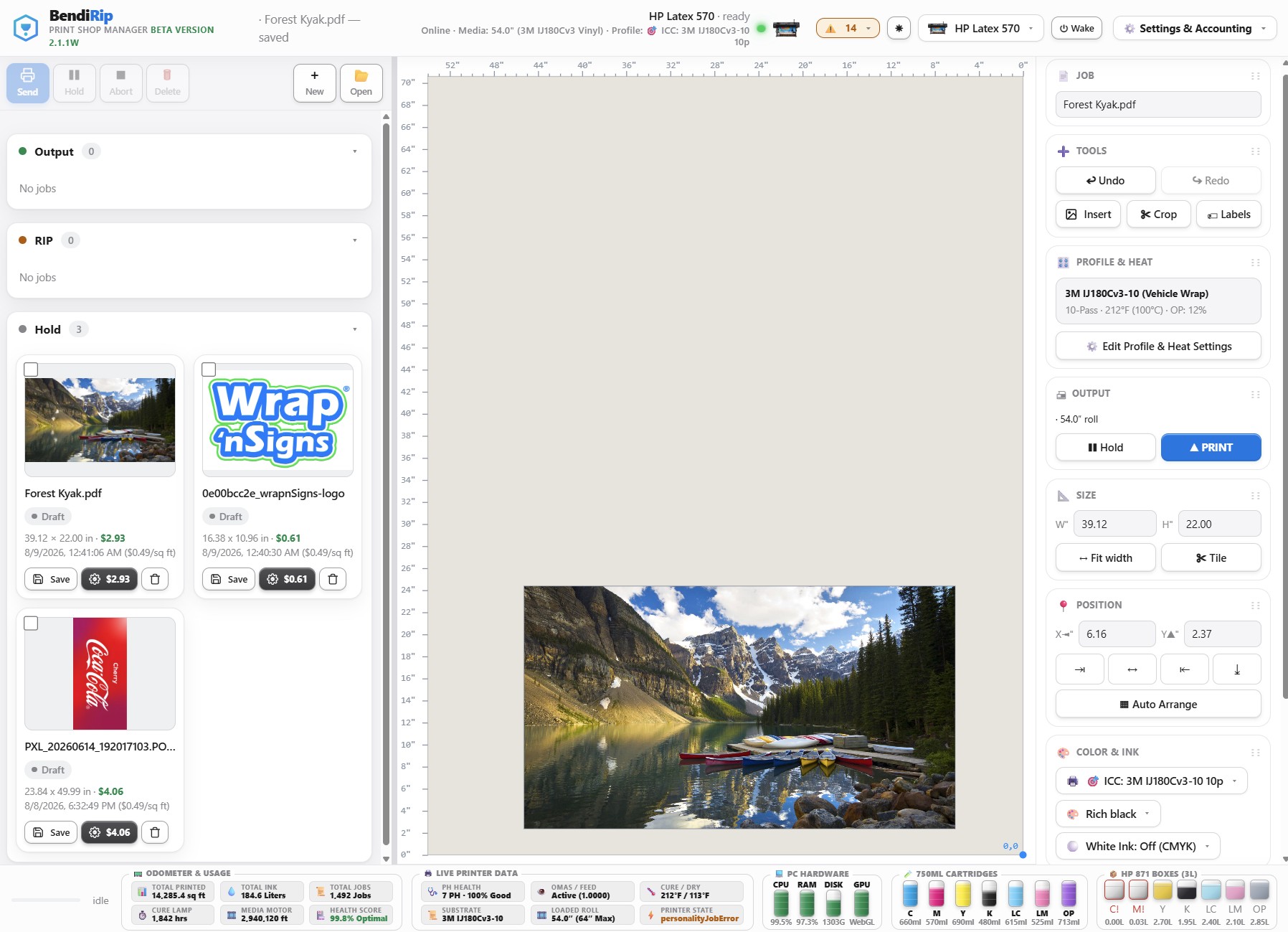
- Local-Area Network Sharing: Open the BendiRip dashboard in any web browser on any Mac, PC, or iPad connected to your shop's Wi-Fi or Ethernet. Designers can drop print jobs directly into the queue from their graphic design workstations without paying for extra software seats.
- Open-Format Transparency: BendiRip preserves your independence. Your jobs, color configurations, and cut paths are stored in standard PDF, ICC, and SVG formats—guaranteeing you are never locked into a closed proprietary container.
5. 3-Step Plan to Break Free from Recurring Subscription Fees
Transitioning your shop away from recurring software rental is simple and can be done without interrupting your live production schedule:
Before canceling any subscription, batch-export your frequent reprint templates and customer logos from Flexi into industry-standard PDF/X-4 files with vector spot color cut contours preserved.
Install BendiRip side-by-side with your existing RIP. Configure your HP Latex, Epson SureColor, Roland, or Mimaki printers via standard Ethernet TCP/IP sockets and test spooling with live jobs.
Once your prepress team confirms that print speeds, color fidelity, and contour cutting workflows meet or exceed your standards, cancel your recurring SAi subscription and immediately redirect that cash flow directly to your shop's bottom line.
Stop Renting Your RIP. Own It for Life.
Join hundreds of commercial print shops saving thousands of dollars every year with BendiRip Suite's perpetual lifetime license.
View BendiRip Lifetime Licensing Options →Frequently Asked Questions
1. SA International (SAi). Flexi Subscription Tiers & Pricing Documentation (2024).
2. Specialty Graphic Imaging Association (SGIA) / PRINTING United Alliance. Commercial Print Facility Operating Benchmarks & Technology Expenditures Survey.
3. Harvard Business Review. The Real Cost of SaaS Software Proliferation on Small and Mid-Sized Businesses.
4. International Color Consortium (ICC). Open Standard Color Exchange vs. Proprietary Color Spaces.