
EFI Fiery XF & Command WorkStation Alternative: Modern Sub-Second Fleet Telemetry
1. The Overhead of Legacy Commercial RIP Servers
For enterprise print service providers and commercial offset shops transitioning into wide-format production, Electronics for Imaging (EFI) Fiery XF and Command WorkStation (CWS) have historically been the default standard for proofing and digital press management. Fiery built its reputation on strict G7 and ISO 12647-7 color compliance, offering deep spectrophotometer integration for commercial prepress proofing.
However, when applied to high-volume wide-format signage, vehicle wraps, and banner production, Fiery XF introduces significant friction that undermines shop floor productivity:
- The Software Maintenance Agreement (SMA) Tax: Fiery XF licenses are notorious for mandatory annual maintenance contracts. An initial server setup often costs between $3,500 and $7,500, with recurring SMA charges running $1,200 to $2,500 per year. If a shop lets its SMA lapse, EFI blocks access to new printer drivers, OS compatibility updates (such as Windows 11 updates), and spot color library expansions.
- Bloated Client-Server Architecture: Fiery Command WorkStation is a heavy application consuming gigabytes of system memory on client workstations. Prepress designers frequently report sluggish launch times, frequent background polling freezes, and connection dropouts when communicating across busy corporate LANs.
- Proofing-Centric UI Built for Offset, Not Signage: Fiery XF was engineered primarily around contract proofing and digital presses. Everyday sign shop tasks—such as generating 2-inch panel overlaps with bleed, calculating grommet placement, or configuring dual-head contour cuts on an HP Latex or Graphtec cutter—require navigating deeply buried sub-menus and separate utility modules.
Over a standard five-year equipment lifecycle, a four-printer commercial print facility running Fiery proServer or Fiery XF typically spends upwards of $12,000 to $16,000 purely in software licensing, printer connection add-on packs, and recurring SMA fees—before accounting for the dedicated server hardware required to host the Fiery RIP core.
2. Architectural Comparison: Fiery XF vs. BendiRip Suite
BendiRip was conceived to replace bloated legacy RIP servers with a sleek, ultra-fast Windows-native service paired with a modern WebGL-accelerated canvas. Where Fiery relies on multi-layer middleware, BendiRip establishes direct TCP socket links straight to the printer hardware.
| Technical Capability | EFI Fiery XF & CWS | BendiRip Suite |
|---|---|---|
| Licensing & Maintenance | $3,500+ upfront + $1,500/yr recurring SMA | Perpetual lifetime license (zero annual fees) |
| System Resource Consumption | 4GB+ RAM idle; dedicated server required | Under 350MB RAM footprint; runs on standard PC |
| Telemetry & Status Polling | Heavy middleware polling (5–15 sec latency) | Sub-second (250ms) direct SNMP & raw socket telemetry |
| Multi-Workstation Access | Heavy Command WorkStation client install | Instant browser-based web access across local network |
| Contour & Perf Cutting | Requires external Fiery Cut Server add-on ($$$) | BendiCut built-in free with ARMS & OPOS mark support |
| Color Engine Architecture | Fiery Color Profiler Suite / APPE | LittleCMS 2.16 with 16-bit floating-point precision |
| Nesting & Tiling Workflow | Static step-and-repeat; rigid overlap logic | True-shape vector nesting + dynamic grommeting |
3. Sub-Second Telemetry: Direct TCP/IP Hardware Sockets
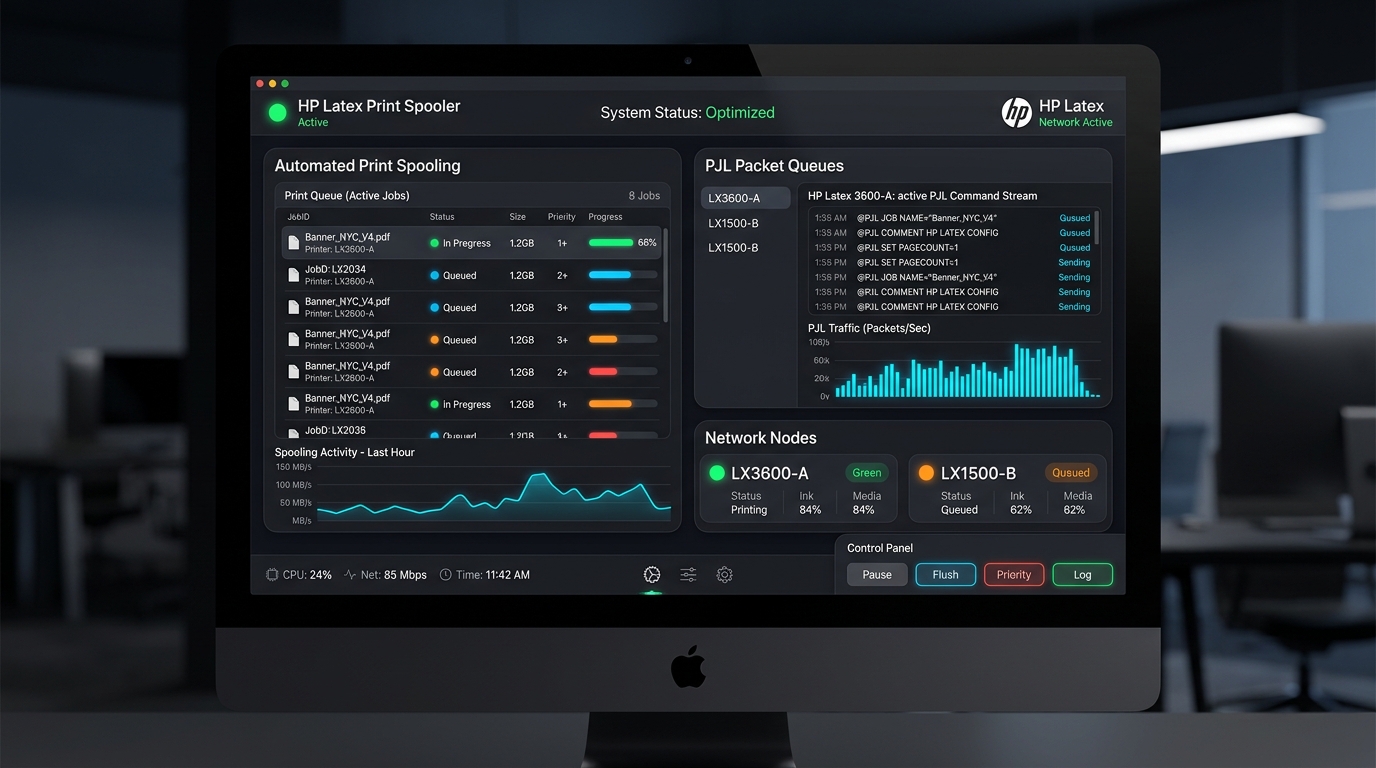
One of BendiRip's standout technical innovations is its low-level hardware communication pipeline. While Fiery Command WorkStation relies on a multi-tier polling engine that queries the Fiery server daemon—which in turn queries printer controllers—BendiRip establishes direct, asynchronous TCP/IP streams to port 9100, port 5000, and standard UDP broadcast ports.
Through bidirectional SNMP and proprietary PJL status queries, BendiRip polls printer hardware every 250 milliseconds with minimal CPU overhead:
- Live Substrate Thermocouple Monitoring: On HP Latex 365 and 570 series printers, BendiRip tracks drying zone temperatures and curing platen heat curves in real time, alerting operators before media deformation or vinyl buckling occurs.
- Dynamic Ink Consumption Telemetry: Rather than estimating ink usage through software-based pixel counters, BendiRip queries the microchip data directly from OEM cartridges on Epson SureColor and Mimaki machines, giving shop owners exact milliliter usage and precise job costing per square foot.
- True Bidirectional Buffer Management: BendiRip monitors the hardware print buffer status, throttling raster streaming to match printhead consumption perfectly, completely preventing buffer underruns during high-speed banner runs.
4. Enterprise Color Precision Without Enterprise Friction
A common justification for paying Fiery's steep licensing fees is color management. Print shops are led to believe that only proprietary APPE/Fiery algorithms can accurately reproduce difficult corporate spot colors.
BendiRip disproves this assumption by leveraging LittleCMS 2.16, an open, mathematically rigorous color management system trusted by high-end imaging applications worldwide.
- 16-Bit Floating Point Pipeline: Eliminates posterization and banding in subtle gradients, pastel vignettes, and shadow drop-offs on high-pass backlit graphics.
- Full ICC v4 Compliance: Supports multi-dimensional N-channel ICC profiles, including White, Metallic, Orange, Green, and Violet gamut extensions on Epson UltraChrome GS3 and Roland TrueVIS TR3 ink sets.
- Spectral Delta-E Optimization: Compares target spot color Lab values against device gamuts using the CIE ΔE 2000 formula, ensuring that critical brand colors match specifications across mixed fleets.
5. Transitioning from Fiery XF: A Seamless 4-Step Rollout
Switching your production floor from EFI Fiery to BendiRip takes less than 30 minutes per workstation. Here is how leading shops make the switch:
Install the lightweight BendiRip daemon on your primary shop workstation. Unlike Fiery, BendiRip does not require dedicated server OS licenses, proprietary RAID arrays, or external dongle hubs.
Click "Auto-Discover" inside BendiRip. The built-in network scanner identifies all HP Latex, Epson SureColor, Roland, and Mimaki printers on your subnet, automatically configuring IP sockets and bidirectional status telemetry.
Export your custom media profiles from Fiery XF or your spectrophotometer software (X-Rite i1Profiler or Barbieri). BendiRip imports standard ICC profiles seamlessly, preserving your established linearization curves and ink limits.
Designers can now open BendiRip in Chrome, Safari, or Edge on any Mac or Windows PC in the shop, drop PDF/X-4 files into the queue, review true-shape vector nesting, and spool directly to production without running heavy client software.
Eliminate Fiery SMA Fees & Modernize Your RIP Fleet
Experience sub-second hardware telemetry, lightning-fast PDF rasterization, and perpetual lifetime ownership with BendiRip Suite.
Download BendiRip Suite Today →Frequently Asked Questions
1. Electronics for Imaging (EFI). Fiery XF 7 & Command WorkStation Administration Guide (2024).
2. IDEAlliance. G7 Specification and Characterization Guidelines for Wide-Format Inkjet.
3. International Organization for Standardization. ISO 12647-7: Graphic Technology — Proofing Processes.
4. Hewlett-Packard Development Company. HP Latex Raw Socket and PJL Communication Reference Manual.